From Paris to Amsterdam, we spent October at the forefront of enterprise Wi-Fi standards development - here's what carriers and enterprises need to know about the future of network authentication.
The ongoing changes to enterprise Wi-Fi are driven by emerging standards, increasing security requirements, and the relentless growth of connected devices. In October 2025, our team attended two critical industry events that are shaping the future of Wi-Fi authentication and network access control: the Wireless Broadband Alliance's Wireless Global Congress and Network X in Paris, and the Wi-Fi Alliance member meeting in Amsterdam.
We saw that carriers are grappling with Wi-Fi offloading challenges despite massive 5G investments. Enterprise networks face mounting pressure to support exponential device growth whilst maintaining security. And the standards bodies - IETF, WBA, and Wi-Fi Alliance - are actively collaborating to address these challenges through improved authentication protocols and deployment frameworks.
Here's what we learned, and why it matters for your network.
Wi-Fi offloading remains critical for carriers
Despite the hype around 5G, Wi-Fi offloading continues to be a major concern for telecommunications providers. Even carriers that provide both Wi-Fi and 5G services struggle with effective traffic management between the two networks.
A recent Airties survey presented ahead of the Network X conference found that 18% of US consumers switched providers last year, with quality of service cited as the primary reason. When these customers switched, 70% paid the same or more than their previous provider, demonstrating that price isn't the deciding factor. Instead, reliability drives customer decisions.
The scale of the problem is significant. Roughly 50% of survey respondents experienced connectivity failures. Consumers now expect Wi-Fi to be as reliable as utilities like electricity or water. According to Metin Taskin, CEO of Airties, $124B in value is lost every year through customer churn and $71B is spent by ISPs just to replace churned customers.
What's particularly concerning for carriers: despite these losses, proactive quality of service monitoring remains largely neglected. Some discussion centred on using AI tools to detect service drops before customers contact support, but adoption appears minimal. For ISPs managing authentication infrastructure at scale, this represents both a challenge and an opportunity.
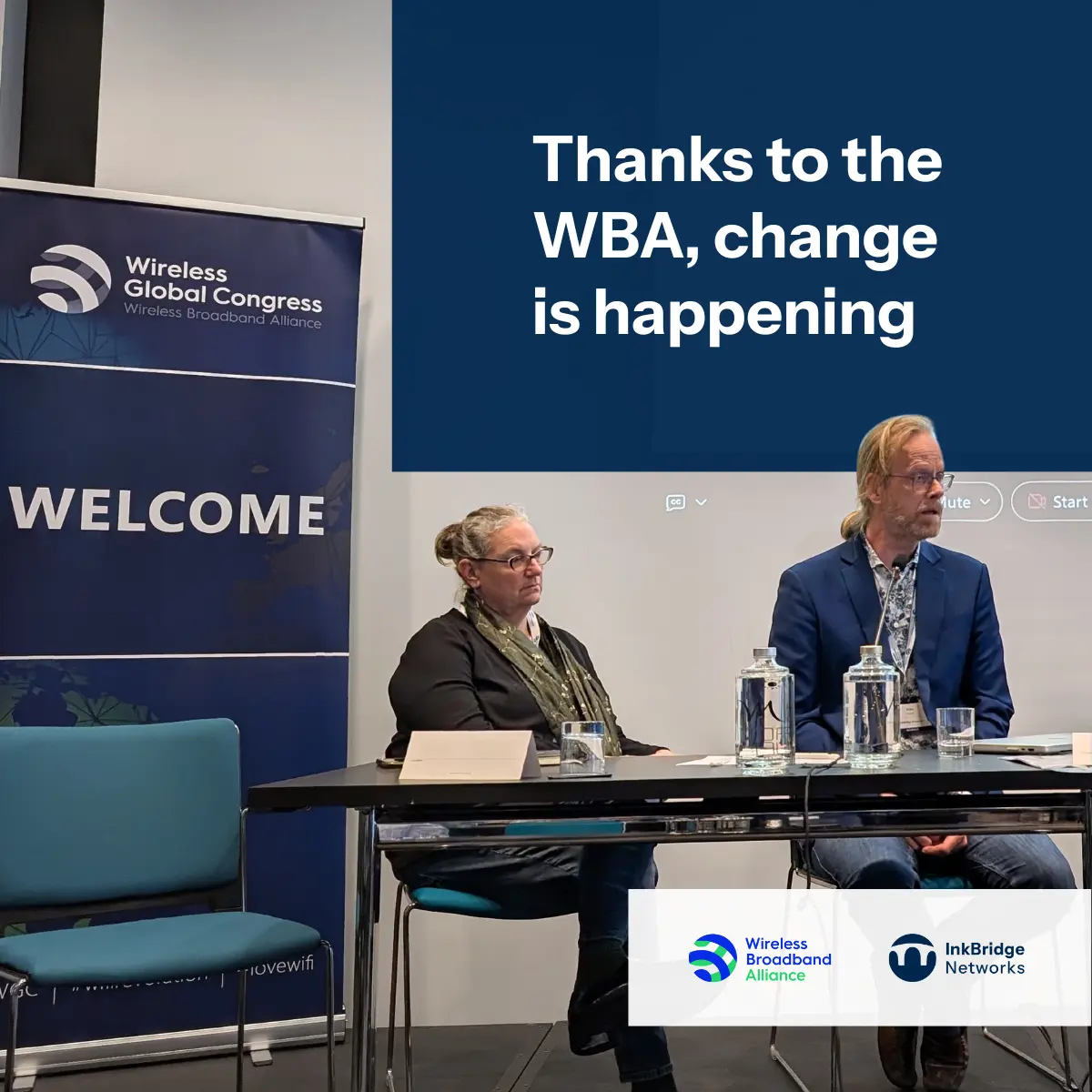
Industry leaders gathered in Paris for WBA's Wireless Global Congress to address carrier Wi-Fi challenges
The authentication backbone of global education networks
One of the most significant deployment stories in enterprise Wi-Fi authentication often goes unnoticed: eduroam. This global roaming service now spans 38,000 institutions across 101 countries, providing seamless Wi-Fi access for students, researchers, and staff as they move between universities, research facilities, and participating municipalities.
Back in 2024, eduroam processed 8.4 billion authentications, and we’re looking forward to getting the 2025 numbers. This critical infrastructure requires strongauthentication at scale, and FreeRADIUS provides that support.
We had the opportunity to meet with Klaas Wierenga, the founder of eduroam. We also connected with Paul Dekkers from surf.nl, whose PhD thesis focused on eduroam and who was the first person after Klaas to work on the project.
The significance of this eduroam deployment cannot be overstated. When billions of authentication requests depend on your infrastructure, reliability isn't optional. The fact that FreeRADIUS serves as the foundation for this global network demonstrates the scalability and reliability that enterprise Wi-Fi deployments require.
Both InkBridge Networks and GÉANT have events planned to mark eduroam's 25th anniversary. Details are still being finalised, but this milestone represents an opportunity to recognise not just the longevity of the service, but the critical role that robust authentication infrastructure plays in enabling global collaboration.
Stay tuned for more information about these upcoming celebrations.

Meeting up with eduroam founder Klaas Wierenga in Utrecht
Collaboration across the competitive landscape
At these events, we deepened our relationships with both Cisco and Microsoft. While we're all technically competitors in the network infrastructure space, we're also united in our shared commitment to improving Wi-Fi experiences for end users.
This collaboration manifests in our joint standards work at the IETF, WBA, and Wi-Fi Alliance. Together, we're developing improved protocols for IoT device provisioning - work that will lay the foundation for the future as connected devices continue to proliferate.
The standards work happening today might seem abstract, but it addresses real problems. How do you securely provision thousands of IoT devices across an enterprise network? How do you ensure authentication protocols remain secure against evolving threats? How do you enable seamless roaming while maintaining network access control?
These are challenges that ISPs and enterprises face today, and the answers being developed through collaborative standards work will define what's possible tomorrow.

Alan DeKok and Jana Sedivy of InkBridge Networks with Charlie Allgrove of GlobalReach during a WBA working group meeting.
Wi-Fi Passpoint: promise and reality
The Wi-Fi Alliance spent considerable time discussing Passpoint, their standard designed to make Wi-Fi configuration easier through automated profile installation. The "honest" version of this discussion: they spent 30 minutes examining why their Passpoint profiles don't work as intended. Many elements are broken, and operating system vendors frequently implement the specification incorrectly.
The "marketing" version: the Wi-Fi Alliance continues to expand interoperability and testing for their Wi-Fi specifications. At the conference, most attendees successfully used Passpoint profiles to auto-join the Wi-Fi network.
One significant challenge highlighted: many enterprise devices are locked down, meaning users cannot install new Wi-Fi profiles without IT administrator access. The Wi-Fi Alliance is working on solutions, though implementation remains in progress.
For ISPs and enterprises, the Passpoint situation illustrates a broader truth about standards: specification is only the first step. Real-world interoperability requires extensive testing, vendor cooperation, and often, workarounds for implementation gaps.
The Diameter protocol: fading but not dead
An important development for network authentication: the Diameter protocol has been officially dropped by 3GPP in favour of REST API calls. However, the transition isn't straightforward. It now requires 11 API calls to establish a connection, raising questions about efficiency and complexity.
While Diameter is slowly fading, it's not yet obsolete. At the IETF meeting in November, discussions focused on how to improve the transition and address remaining use cases.
For authentication infrastructure planning, this transition highlights the importance of flexible systems that can adapt to evolving standards. Betting on any single protocol carries risk. Building on foundations that can accommodate multiple approaches - like FreeRADIUS support for various authentication methods - provides long-term resilience.
Wi-Fi sensing: innovation or privacy concern?
Wi-Fi sensing received more prominence at these events compared to the May conference in Dallas. The technology essentially turns Wi-Fi access points into sensors capable of detecting movement and presence through walls.
Vendors assured attendees they are "taking privacy very seriously" and "following all privacy laws." For enterprises and ISPs deploying this technology, the privacy implications require careful consideration. What data is collected? How is it stored? Who has access? What are the legal requirements in different jurisdictions?
The technology offers legitimate use cases - occupancy monitoring, security applications, and space utilisation analysis. But deployment without clear privacy frameworks and user consent mechanisms could create significant liability.
Strategic relationship building
These industry events also provided opportunities to strengthen relationships and explore potential collaborations:
Benoit Claise (formerly of Cisco and Huawei): While there's no immediate business opportunity, Benoit maintains extensive contacts at ISPs and enterprises dealing with network monitoring and security challenges.
SecureW2: We had dinner with their team to discuss implementation of new IETF standards. They raised $80 million in funding two years ago but remain relatively small. They're still using version 3 for database access, and we've pointed them toward version 4. Their high-load environment will provide valuable feedback on FreeRADIUS version 4 performance.
These relationships matter because enterprise Wi-Fi authentication isn't a commodity market. Organisations evaluating authentication infrastructure want to work with vendors who are actively engaged in standards development, who maintain relationships across the industry, and who can provide insight into emerging trends.
What this means for your network
For ISPs and enterprises managing Wi-Fi authentication infrastructure, several themes emerge from these industry events:
Quality of service monitoring remains critical: With customers switching providers over reliability issues rather than price, proactive authentication infrastructure monitoring can prevent problems before they impact user experience.
Scale matters: When eduroam can process 8.4 billion authentications annually on FreeRADIUS, it demonstrates what properly implemented authentication infrastructure can achieve. Your network might not reach that scale, but the principles that enable it - robust design, careful implementation, ongoing monitoring - apply at any size.
Standards work continues to evolve: The transition from Diameter to REST APIs, improved IoT provisioning protocols, and ongoing Passpoint interoperability work all represent active development. Authentication infrastructure built on flexible, standards-compliant foundations will adapt more easily than proprietary locked-in solutions.
Collaboration drives innovation: The fact that competitors like InkBridge Networks, Cisco, and Microsoft collaborate on standards development at WBA and Wi-Fi Alliance benefits everyone. Better protocols, improved interoperability, and shared security improvements raise the baseline for the entire industry.
Privacy considerations are increasing: As Wi-Fi sensing and similar technologies emerge, enterprises and ISPs will need clear frameworks for data collection, storage, and use. Getting ahead of these concerns through policy and technical controls will be easier than retrofitting privacy protections later.
Need help?
InkBridge Networks has been at the forefront of network infrastructure for over two decades, tackling complex challenges across various protocols. If your organisation
is facing Wi-Fi authentication challenges, exploring infrastructure
upgrades, or evaluating whether your current solution can scale to meet
future demands, we'd be pleased to discuss how our experience supporting critical infrastructure can help address your specific requirements. You can request a quote here.
Related Articles

Client Case Study: Network authentication at scale
65% fewer authentication failures. 40% drop in support tickets. How InkBridge Networks is helping educational institutions by transforming their eduroam experience with protocol-level fixes.

Steel-Belted RADIUS Server End-of-Life: What You Need to Know Now
If you're still running Steel-Belted RADIUS server (SBR), you're operating on borrowed time. SBR Enterprise and Global Enterprise reached end-of-life on December 31, 2020. The Carrier Edition's End of Engineering came on February 28, 2023, followed by End of Support on September 30, 2023.